Small businesses often need additional credit for working capital, expansion, machinery purchases, or short-term liquidity gaps. Small businesses often need additional credit for working capital, expansion, machinery purchases, or short-term liquidity gaps. To improve credit access, the Government of India offers several financing and credit guarantee schemes for eligible enterprises.
The Emergency Credit Line Guarantee Scheme (ECLGS) supports eligible Micro, Small, and Medium Enterprises (MSMEs) and other borrowers through additional credit. At the same time, the Credit Guarantee Fund Trust for Micro and Small Enterprises (CGTMSE) follows a different approach to credit guarantee support.
A CGTMSE loan can serve broader eligible funding requirements through participating lenders. Understanding their eligibility, guarantee cover, costs, and repayment conditions helps businesses select suitable financing.
What are ECLGS and CGTMSE?
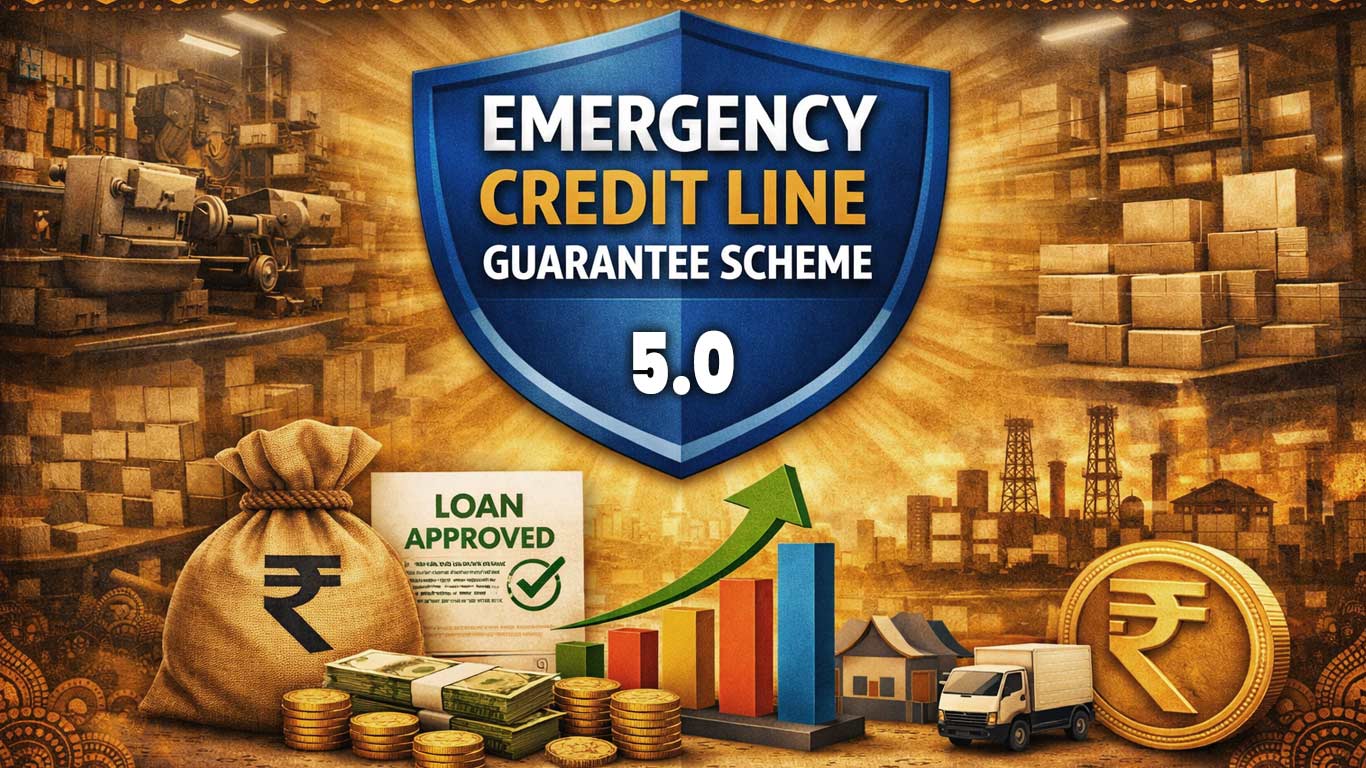
ECLGS 5.0 provides additional working capital support to eligible existing borrowers through government-backed credit guarantees. The National Credit Guarantee Trustee Company Limited (NCGTC) provides guarantee cover to registered Member Lending Institutions (MLIs).
CGTMSE supports eligible Micro and Small Enterprises (MSEs) by providing guarantee protection on qualifying credit extended by participating lenders. A CGTMSE loan may include term finance, working capital, or other eligible credit facilities.
| Feature | ECLGS 5.0 | CGTMSE |
| Primary Purpose | Additional liquidity for eligible existing borrowers | Wider credit access for eligible MSEs |
| Borrower Status | Existing borrower required | New or existing eligible MSE |
| Guarantee Provider | NCGTC | CGTMSE |
| Direct lending | No | No |
Who Can Qualify Under Each Scheme?
Eligibility differs considerably because ECLGS 5.0 focuses on existing borrowers, while CGTMSE can support eligible new and existing enterprises.
- MSMEs must have existing working capital facilities with MLIs as of 31 March 2026 for ECLGS eligibility.
- Eligible accounts must remain standard and should not fall under Special Mention Account-2 (SMA-2) classification on the reference date.
- ECLGS applies across sectors for qualifying MSMEs, subject to the prescribed borrower and account conditions.
- A CGTMSE loan can support eligible new and existing MSEs meeting scheme and lender requirements.
- CGTMSE covers permitted manufacturing, services, trading, and other qualifying business activities.
- Udyam registration applies under the respective schemes when establishing eligible MSME or MSE status.
How do Credit Limits and Guarantee Coverage Differ?
The two schemes calculate support differently, so businesses should assess their existing credit exposure, funding purpose, and sanctioned working capital limits.
| Parameter | ECLGS 5.0 | CGTMSE |
| Funding Basis | Existing working capital utilisation | Eligible credit sanctioned by lender |
| Additional MSME Funding | Up to 20% of peak Q4 FY2025-26 working capital utilisation | Based on approved eligible facility |
| Maximum Support | Up to ₹100 crore for eligible MSMEs | Up to ₹10 crore through specified MLIs |
| MSME Guarantee Coverage | 100% | Generally 75% to 90%, depending on category |
| Working Capital | Eligible | Eligible |
| Term Finance | Governed by ECLGS structure | Eligible |
Under ECLGS, additional MSME credit is linked to peak fund-based working capital utilisation during January to March 2026. Under CGTMSE, guarantee percentages vary according to borrower category, location, and facility size. Women-led enterprises can receive higher coverage under current provisions.
These differences can affect the available credit limit, lender risk exposure, and overall funding structure of the business.
How do Interest Rates, Fees, and Repayment Terms Compare?
Financing costs influence operating margins, cash flow, cost of capital, and debt-servicing capacity throughout the repayment period.
| Cost Factor | ECLGS 5.0 | CGTMSE |
| Guarantee Fee | Nil | Annual Guarantee Fee applies |
| Processing Fee | Nil for ECLGS facility | Depends on lender |
| Prepayment Penalty | Nil | Depends on lender terms |
| Interest Pricing | Subject to prescribed ECLGS ceilings | Determined by lender |
| Repayment Tenure | Five years for eligible MSME facilities | Depends on sanctioned facility |
For bank and financial institution lending under ECLGS, MSME pricing follows the applicable External Benchmark Lending Rate (EBLR) plus 0.75%. The rate is capped at 9% annually under current scheme rules.
NCGTC does not charge a guarantee fee under the scheme. MLIs also cannot charge processing fees or prepayment penalties on qualifying facilities. A CGTMSE loan, however, can involve an Annual Guarantee Fee (AGF) alongside lender interest and other applicable charges. Borrowers should therefore compare total borrowing costs.
Borrowers should therefore compare the effective borrowing cost, repayment tenure, and expected cash flows before selecting either facility.
How do Security Requirements Differ?
Security requirements influence collateral coverage, lender risk, and the structure of the borrower’s overall credit exposure.
| Security Aspect | ECLGS 5.0 | CGTMSE |
| Fresh Collateral | MLIs cannot seek fresh collateral for qualifying MSME credit under ECLGS 5.0. | CGTMSE generally supports eligible unsecured credit facilities. |
| Personal or Corporate Guarantee | No fresh personal or corporate guarantee is required for qualifying MSME facilities. | Third-party guarantees are generally not required for standard eligible coverage. |
| Charge on Security | The ECLGS facility generally ranks as a second charge alongside existing eligible security. | CGTMSE does not require full collateral for standard eligible facilities. |
| Hybrid Security | Not the standard structure under ECLGS 5.0. | Hybrid Security allows collateral for one portion and guarantee cover on the eligible unsecured portion. |
| Final Sanction | Subject to lender assessment, documentation, and scheme eligibility. | Subject to lender appraisal, documentation, and CGTMSE eligibility. |
In both cases, final sanction still depends on credit appraisal, repayment capacity, account conduct, and lender-specific underwriting requirements.
Which Scheme May Suit a Small Business Better?
The right choice depends on existing borrowing, funding purpose, eligibility, and repayment capacity rather than guarantee coverage alone.
| Business Situation | Option to Explore |
| Existing Eligible Borrower Requiring Additional Liquidity | ECLGS 5.0 |
| New Eligible MSEs Seeking Business Finance | CGTMSE-backed credit |
| Business Requiring Term Loan For Expansion | CGTMSE-backed credit |
| Existing Msme Facing Short-term Working Capital Pressure | ECLGS 5.0 |
| Enterprise Lacking Sufficient Traditional Collateral | CGTMSE-backed credit |
| Eligible Borrower Seeking Additional Credit Without Fresh Collateral | ECLGS 5.0 |
ECLGS is currently operational until 31 March 2027, or until guarantees reach ₹2.55 lakh crore, whichever occurs earlier. Businesses should compare working capital gaps, projected cash flows, debt obligations, cost of funds, and repayment capacity before choosing a route.
Choose the Right Credit Support for Your Business
ECLGS and CGTMSE address different credit requirements, although both reduce lending risk for participating financial institutions. ECLGS mainly supports additional liquidity for eligible existing borrowers, while CGTMSE covers broader qualifying MSE financing requirements.
Businesses should compare interest expense, guarantee charges, loan tenure, working capital needs, and debt-servicing capacity before borrowing. Financial institutions like HDFC Bank can help eligible enterprises understand suitable credit structures and documentation requirements. The right facility should strengthen liquidity without placing unnecessary pressure on repayment capacity or operating cash flow.
Also Read: HDFC Bank reports 14 pc jump in deposits at Rs 11.32 lakh crore