Vidya Sethuraman
India Post News Service
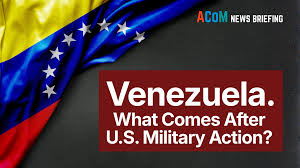
After months of escalating U.S. military pressure against Venezuela, events shifted dramatically a few days ago with direct U.S. military action and the removal of the country’s ruler, Nicolas Maduro. Venezuela now faces urgent questions about governance, legitimacy, and democratic recovery. Amidst ongoing tensions between the United States and Venezuela, American Community Media (ACoM) held an online briefing on Jan 9th, inviting several experts on Latin America, International law, and energy policy to analyze the latest developments in Venezuela and the potential ripple effects of related U.S. policies.
Mariano de Alba, Venezuelan lawyer. Geopolitics, International Law, and Diplomacy analyzed the situation from an International law perspective, pointing out that the international order established after World War II places clear restrictions on the use or threat of force. He stated that such actions are difficult to consider legal unless authorized by the UN Security Council or justified under the conditions of self-defense. He emphasized that even if there are widespread doubts about the democratic legitimacy of the Venezuelan leadership, this is not sufficient grounds under international law to justify the use of force. Alba pointed out that Washington often uses oil, drugs, and immigration as the main justifications for its policies towards Venezuela, but these claims are exaggerated. He stated that most Venezuelan immigrants in the United States are ordinary people forced to leave their country due to economic hardship and seeking a livelihood, and equating them as a whole with crime or security threats is not accurate.
Alejandro Velasco, Gallatin School and the Department of History at New York University, Executive Editor of the NACLA Report on the Americas said based on his interactions with family and friends in Venezuela, three emotions are currently prevalent in Venezuelan society: anxiety, confusion, and a nascent sense of “anticipation.” The anxiety stems from the sudden shift in the situation and the high degree of uncertainty about the future; the confusion arises from the unclear nature of whether the power structure has truly changed; and the so-called anticipation is not genuine hope, but rather the feeling that the long-stagnant political situation seems to be loosening up, leading some people to watch and see if new political possibilities might emerge. Velasco also cautioned that the U.S.’s current priorities may not be to promote democratic transition, but rather to focus on oil and broader geopolitical strategies.
Roxanna Vigil, International Affairs Fellow, Council on Foreign Relations pointed out from the perspective of energy and sanctions that rebuilding Venezuela’s oil industry requires legal and institutional reforms, the establishment of the rule of law, and attracting long-term investment, which usually requires a democratically legitimate government to accomplish. She also cautioned that the global oil market is currently well-supplied, and Venezuelan crude oil has high refining costs and limited suitable refineries. There is still a gap between the large-scale investment envisioned by the U.S. and the realities of the market.