At the SALA Festival, the author of The Sensual Self speaks about rediscovering the pleasures of the senses, why Gen Z may be losing touch with intimacy, and living life by the ‘why nots’.
Vinaya Patil
For Shobhaa De, sensuality has little to do with the narrow definition the word often evokes. It is, instead, about being fully alive to the world: to beauty, music, fragrance, touch and the pleasures of simply paying attention.
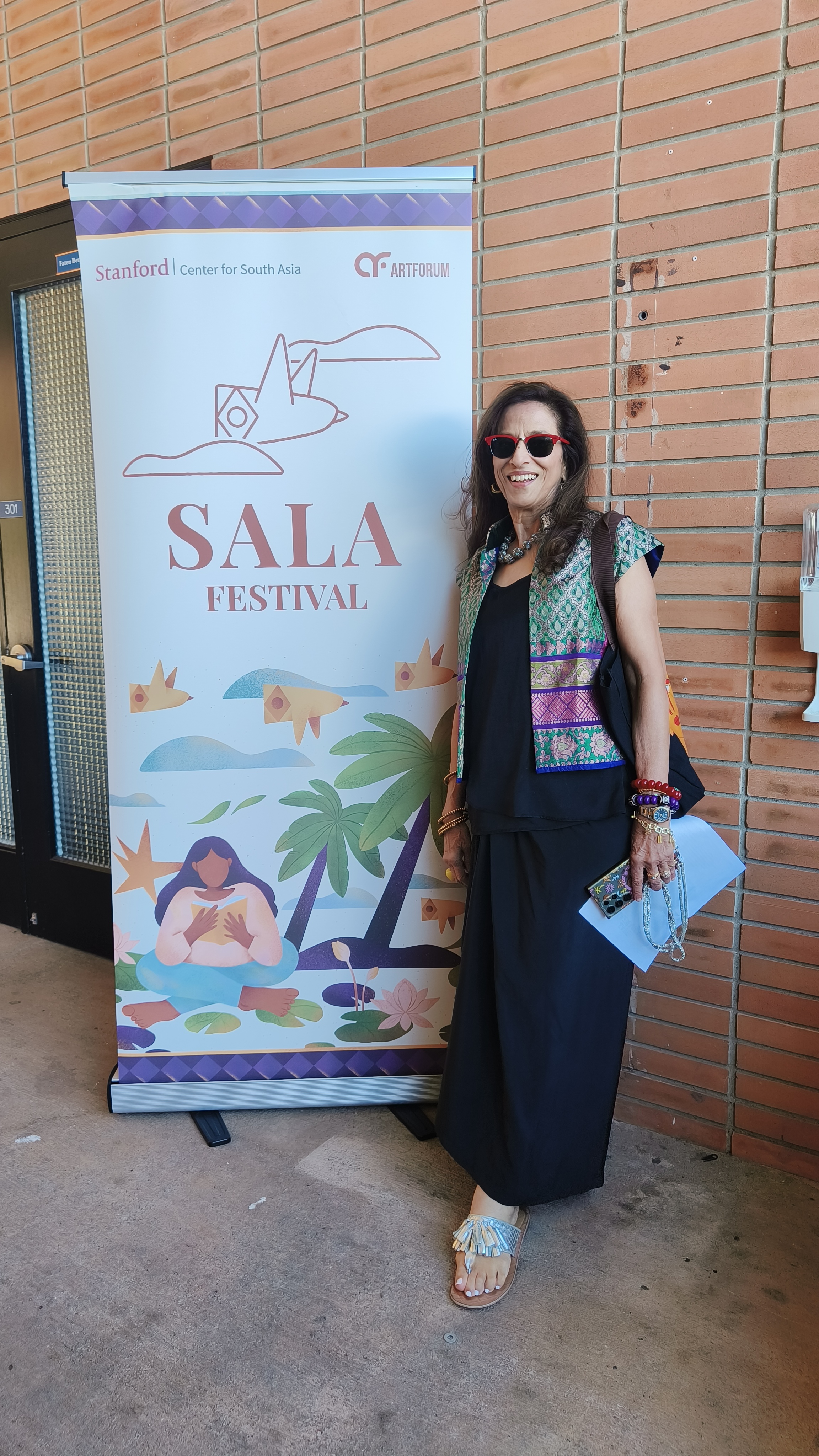
That idea lies at the heart of her latest book, The Sensual Self, which the novelist discussed during a one-on-one conversation with The India Post at the South Asian Literature & Arts (SALA) Festival in the Bay Area.
About questioning her own attitude through the book, whether it has changed over the years, De says that it has and that she also wanted to remind younger readers that they could be “losing out on something significant” by not paying attention to all the five senses. “It’s not about sexuality alone, it’s really much more than that,” she says. “It’s about being sensitive to beauty, to music, to fragrance, to touch.”
For De, everyday life itself can become a sensory experience if one chooses to notice it. “Everything in our life is a feast if we want to look at it like that,” she argues. “Or you can starve yourself and deprive yourself of all the pleasures life has to offer.” Attention to the senses, she believes, was once more intrinsic to Indian life and culture. Today, she sees a generation overwhelmed by the “noise” and stress of everyday existence and increasingly disconnected from some of those older ways of experiencing the world.
 She draws a parallel with India’s renewed appreciation of traditional textiles. As regional weaves and embroideries have found new audiences, she believes there should be a similar revival of the sensual and an appreciation of music, touch, fragrance, beauty and pleasure.
There are signs of that shift though, she adds. Music festivals are attracting young audiences, while conversations around the body and pleasure are no longer quite as taboo as they once were. The problem, however, she feels, is that young people often have few comfortable places to turn for honest conversations about intimacy, bodies and desire. “Indian families, in particular, may not make it easy for children to approach parents with such questions, while information from peers may not always be reliable,” she opines.
De’s book is also, in some ways, a reckoning with her own journey. She readily acknowledges that her attitude toward sensuality has changed significantly over the years. “I think I went through a period where I was denying a lot of things to myself. I was so busy running my life,” she says, adding that she now has consciously tried to reconnect with an older version of herself.
Interestingly, the book’s original title was called Searching for Anuradha — Anuradha being De’s given name as well as her nakshatra. But she eventually decided against a title that sounded too biographical. “How many times am I going to write different versions of my life in a memoir?” she quips.
Instead, she wanted her experiences to serve as one thread in a much larger exploration of sensuality. The book thus draws on observation, things people have shared with her and experiences from her own life. Sensuality, for De, is being in touch with beauty at all levels.
She offers a vivid example of what she means by a sensory life while recalling a recent experience involving her husband and the Rajinigandha flowers. She narrates an incident where her husband had filled the car with “lots of Rajinigandha” at a crucial moment in their life because he knew what the flowers meant to her. The car stereo was also playing one of her favorite qawalis, “Noor Ul Ala” [The Divine Light] from M F Husain’s Meenaxi: A Tale of Three Cities, with music by A R Rahman.
For De, the moment became much more. “It was a combination of sentimentality, and my husband being aware of what those flowers and fragrance mean to me,” she recalls. The experience brought together music, memory, visual imagery, fragrance and affection, precisely the kind of multi-sensory awareness she hopes her readers will rediscover.
On being her forever fearless self
Speaking of her readers who now include the next generation of adults, De says that the Gen Z has access to more information about sex, bodies and relationships than perhaps any generation before it. “I think they’re responding to it very differently,” she says. Their ideas of their bodies, intimacy and relationships are intensely individual, she believes. But she has noticed something else: perhaps they are not seeking intimacy in quite the same way.
“The most intimate relationship they have is with their phone,” says De in her iconic way without much concern for whether everyone will agree. That same fearlessness, she says, remains intact despite living in an age of social media, instant reactions and the ever-present possibility of being misquoted. “I’m not preoccupied by that,” she said. Her philosophy is simple: say what you believe, take responsibility for it and accept that some people may disagree.
“Whatever I say is an opinion that I’m happy to defend if I need to. And I say it with responsibility,” says the novelist while acknowledging that some may find her opinions unpalatable that she’s “okay with that too.”
That includes her much-discussed observation about Prime Minister Narendra Modi, whom she has previously described as a charismatic personality. Does she still stand by it? “A hundred percent,” De says, making it clear that she was separating personal magnetism from political agreement.
“It’s not about his politics. I’m talking about a certain magnetism,” she explains, adding that she sees a similar quality in Russian President Vladimir Putin. “Some people just enter a room and you notice them.”
As for what comes next, De has no carefully mapped-out plan and she likes it that way. “I don’t plan, actually. I’ve never planned,” she says, adding that there’s always room for new possibilities. “The why-nots in my life have defined a lot of my very important decisions.” Whether they turned out to be the best ones is not the point, according to her. “No regrets,” she signs off.
Also Read: Action-packed year for books